A process simulator that tells you what it can't do
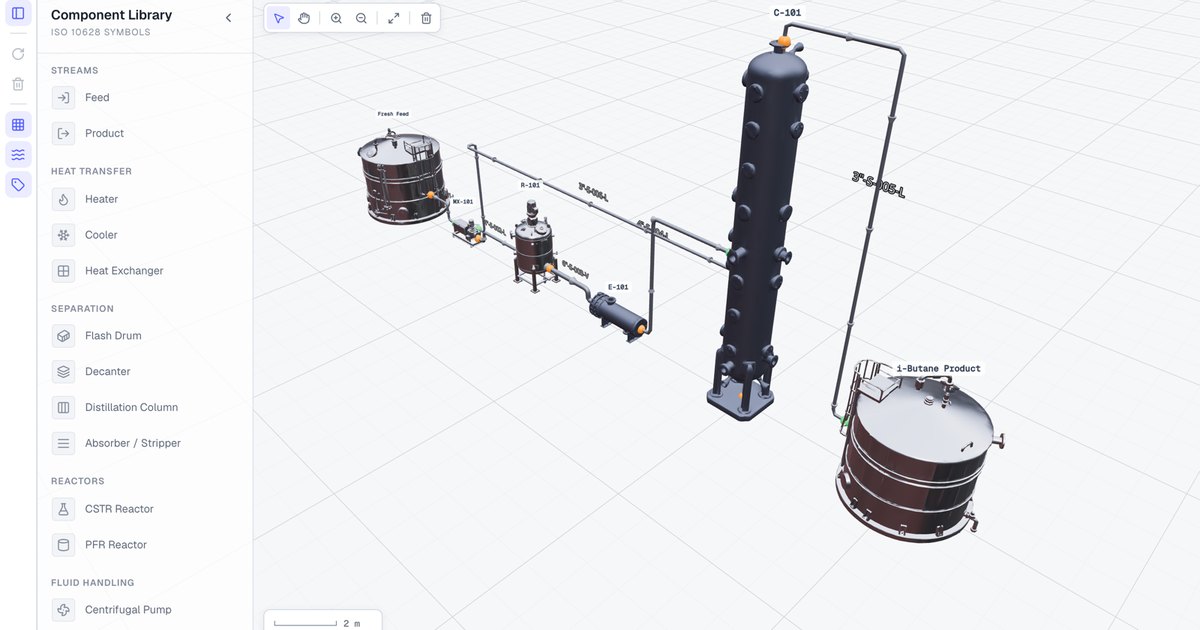
Damkoe builds chemical process flowsheets in the browser and gives you live simulation, economics, safety screening and a generated P&ID on top of whatever you draw. It also grades itself against another simulator, in the app, and publishes every approximation it makes.
Results graded against DWSIM
Inside the app, on a Verification tab. Disagreements that have been diagnosed but not fixed ship as visible failing rows, not widened tolerances.
Documented refusals
Every method states what it will not compute, and why. Two-phase relief sizing is refused naming DIERS, because the vapour equation under-sizes a flashing liquid.
Regression checks
Analytic anchors wherever one exists (the Kremser equation, Gouy–Stodola, Clausius–Clapeyron) rather than values captured from the code's own output.
What it is not
The refusals are the point, so here are the ones most likely to matter before you spend an afternoon on it. The app carries the full list under Methods.
- Distillation
- Rigorous columns run a bubble-point or inside-out solver with no side draws and no multiple feeds. The energy balance closes to about 2% on the reboiler, measured against DWSIM and shipped as a declared gap.
- Thermodynamics
- No binary interaction parameters ship with the cubics: every pair runs k_ij = 0. That is the confirmed cause of most open disagreements in the verification library, and the app warns when a flowsheet depends on it.
- Relief sizing
- Two scenarios only, pool fire and blocked outlet. Two-phase relief is refused outright. A governing case here means the largest of the two that were checked, not the relief basis.
- Coursework
- Assignments and grading are local-first and honor-system: files are unsigned and grading runs on your machine. Nothing leaves the browser, which is also why there is no account to create.
Who built it
Damkoe is a single-developer project. It exists because process simulation is taught on tools that cost more than a department's software budget, run only on Windows, and answer every question with the same confidence whether or not the model behind it applies.
It is MIT licensed and the source is public. If you teach with it and something is wrong, the fastest way to get it fixed is to say so. A disagreement with a number is the most useful thing anyone can send.